








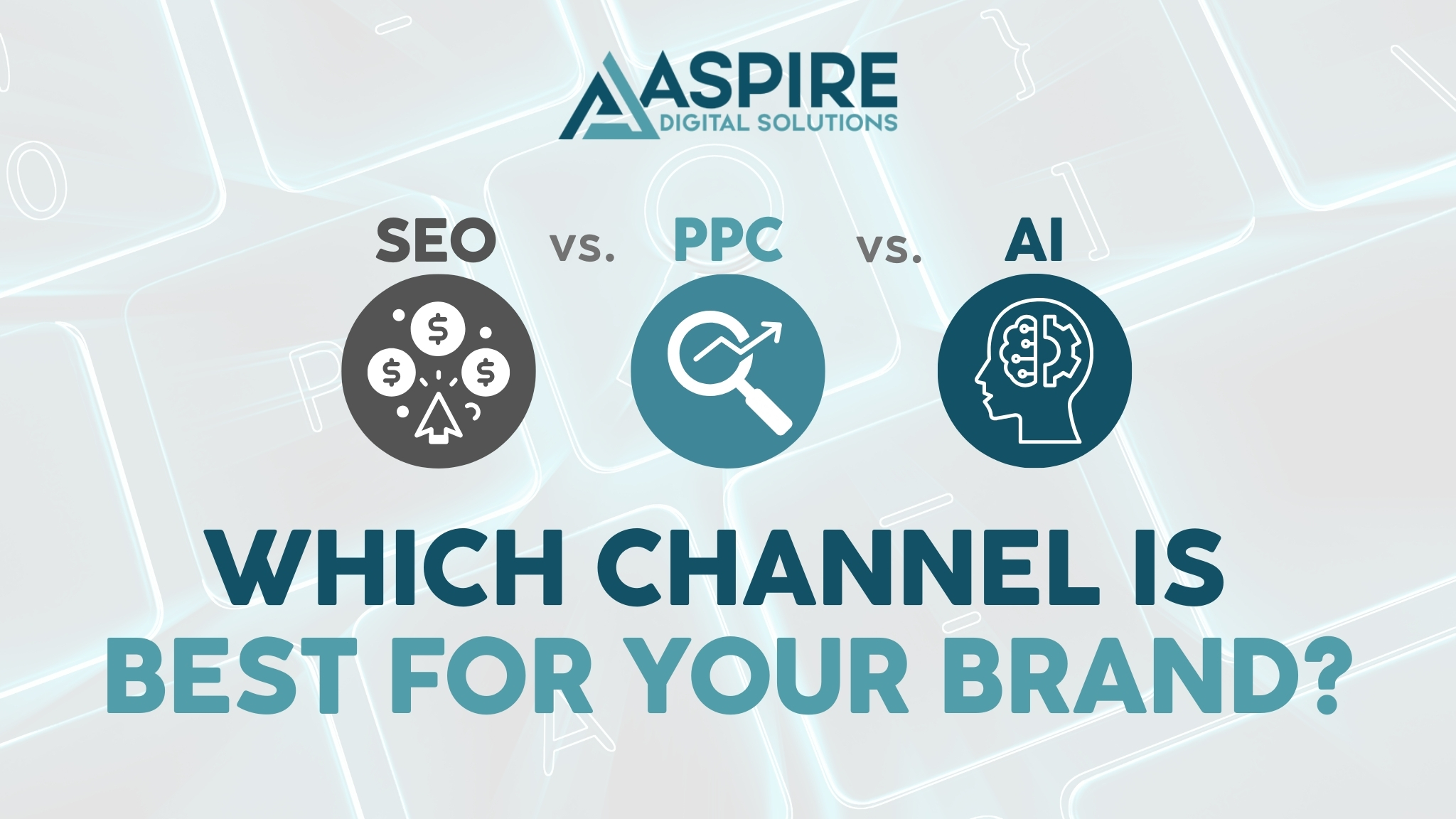
If you’re deciding whether to invest in SEO, PPC, or AI search, it probably feels like you have to pick one and leave the rest behind. In reality, this decision reflects how the buying journey has changed for modern customers.
Today’s customers typically don’t choose a business after a single interaction. They encounter it multiple times, across different channels. Someone might first see your brand in a paid search result. Later, they come across a helpful blog article while researching their options on Google. They may even see your business mentioned in an AI-generated answer that pulls from content on your site. By the time they’re ready to reach out, they’re no longer searching for a service. They’re searching for you.
For businesses in Connecticut, staying competitive means building trust and showing up consistently at as many touchpoints as possible. When your business appears across paid ads, organic search, and AI-driven discovery, it strengthens your presence and credibility everywhere online. Everywhere your brand shows up builds trust, making qualified conversion feel easy and frictionless.
While showing up across every major marketing channel is one of the strongest ways to build trust and drive conversions, not every business needs to do everything at once. The right approach depends on your goals, your timeline, and how your customers actually make decisions.
Whether you’re looking for fast demand, long-term growth, or better visibility at specific points in the buying journey, understanding where SEO, PPC, and AI fit into the mix can help you choose the channel that aligns best with what your business needs right now.
What Is PPC (Pay-Per-Click / Google Ads)?
PPC stands for pay-per-click and generally includes social media advertising, search advertising, and other paid digital placements where you’re charged for each click. For this comparison, though, I’ll focus specifically on PPC as it relates to paid search.
PPC helps your business appear at the top of search results immediately by paying for visibility. With paid search, your ads show up when someone searches for specific keywords, and you’re typically charged whenever your link shows up in a search or when a user clicks through to your page.
Unlike SEO, PPC visibility is not earned over time. It’s rented. When your ads are active, you show up. When you stop spending, so does paid search traffic. That said, PPC offers speed, control, and clarity that other channels can’t always match.
PPC tactics involve:
- Keyword research focused on high-intent searches
- Writing ad copy that aligns closely with search intent
- Landing page creation to convert specific user segments into leads
- Budget and bid management to control costs
- Ongoing testing and refinement to improve performance
PPC Is Best for Businesses That Need:
Fast Leads for Immediate Demand
PPC is ideal when you need immediate visibility. New businesses, new locations, seasonal services, or time-sensitive offers can benefit from showing up at the top of search results without waiting months for organic rankings to develop.
More Control Over Targeting and Budget
Paid search allows you to control exactly when and where your ads appear. You can target specific locations, search terms, devices, times of day, and budgets, making PPC especially useful when demand is predictable and lead value is clearly defined.
A Clearer Short-Term ROI
PPC provides fast feedback. You can see which keywords generate calls or form fills, which messages resonate, and where users drop off. That data can be used to improve landing pages, sales processes, and even inform your SEO strategy.
If you’re considering starting a PPC campaign, it’s important to remember that results can come in quickly, and sustained success depends on continuous optimization and budget management, not just flipping the budget switch on or off at will.
What Is SEO (Search Engine Optimization)?
SEO helps users find you through organic search results on Google. SEO rankings are organic and evergreen, meaning you don’t need to pump money into high visibility placements and those placements typically last a long time once they’ve been acquired.
SEO tactics involve:
- Keyword research that reveals a site’s top SEO opportunities
- Search intent-matched copywriting or on-page optimizations
- Local SEO work (Google Business Profile updates, reviews, etc.)
- Improving technical site health so it can be crawled and indexed by search engines
- Building trust signals like backlinks and branded mentions
SEO Is Best for Businesses That Need:
A Sustainable Lead Engine That Grows Over Time
SEO builds lasting assets for your business. The pages and local presence you invest in can keep attracting qualified traffic over time, even after you stop paying for it. SEO isn’t a quick win. It’s a long-term investment where momentum builds gradually and becomes easier to maintain over time.
Visibility Across a Wide Range of Search Intent
SEO is a clear winner in terms of providing leads from searches like “cost,” “best,” “near me,” “vs,” “how does it work?” and other comparative or investigative queries. SEO really shines when users are narrowing their options and looking for reassurance before reaching out. If your “Ultimate Guide on XYZ” resource is showing up in search above your competitor, it gives you a leg up.
Trust and Local Credibility
Your customers need to trust you in order to consider purchasing from you. Showing up consistently in organic results, having positive business reviews, thorough service pages, and helpful, user-first content, makes you a safe, credible choice in a competitive market. And that can be the difference between someone clicking on your website or moving on to the next one.
If you’re thinking about kicking off an SEO campaign, it’s important to think in months, quarters, and years; not in days or weeks. SEO is a long-term play with big payoff.
What is AI Search Optimization?
In modern marketing, we typically refer to AI search optimization as GEO, or Generative Engine Optimization. GEO focuses on increasing your visibility inside AI-driven chatbot platforms like ChatGPT, Perplexity, and other conversation-based search tools. I’m ignoring Google’s AI overview here, since those results are still largely driven by traditional SEO signals.
Instead of ranking blue links, GEO focuses on making sure your business, services, and expertise are referenced, cited, or recommended when AI systems generate answers to real user questions.
AI platforms pull from the same web ecosystem as traditional search, including websites, structured data, reputable sources, and authoritative content, which means the tactics used to appear in SEO and GEO results have a lot of overlap, but they surface information differently.
GEO tactics involve:
- Aligning page content with SEO keyword data and specific, conversational queries
- Structuring service pages and core content so AI systems can easily understand, summarize, and reference what you do
- Writing clear, direct answers to common customer questions instead of burying or gatekeeping key information
- Gaining trust through backlinks and branded mentions
- Using comparisons, definitions, and explanatory sections that AI systems frequently pull into generated responses
GEO Is Best for Businesses That Need:
A Competitive Edge in Emerging Channels
GEO is still relatively new, which means many businesses haven’t invested in it yet. For brands that want to stay ahead of competitors rather than react later, GEO offers an opportunity to establish authority and visibility in AI-driven search while the space is still taking shape. If your audience is young or tech-savvy, you’ll want to show up in AI search results.
Long-Term Brand Authority, Not Website Traffic
Unlike paid ads and some SEO campaigns, GEO visibility typically isn’t transactional. AI results are mostly clickless search experiences, meaning users are getting all the answers they need directly within an AI search tool.
When your business is consistently referenced as a trusted option in AI search, it builds familiarity and credibility over time, especially in competitive Connecticut markets where trust plays a major role in choosing a provider. But AI citations typically do not directly lead users down a data-attributed traffic funnel like PPC and SEO do.
Reinforcement for Existing Marketing Efforts
Strong AI search performance is typically built on the same foundation as good SEO. Clear service pages, authoritative content, and strong brand signals increase the likelihood of being referenced by AI systems. GEO doesn’t replace SEO or PPC, but it strengthens the impact of both by reinforcing your brand across more touchpoints. If you’re showing up in ChatGPT and your top competitor isn’t, then you have a clear advantage in a customer’s buying journey.
If you’re thinking about starting with GEO, remember that the goal isn’t to replace SEO or PPC. It’s to make sure your brand shows up in a new discovery channel that complements overall marketing goals.
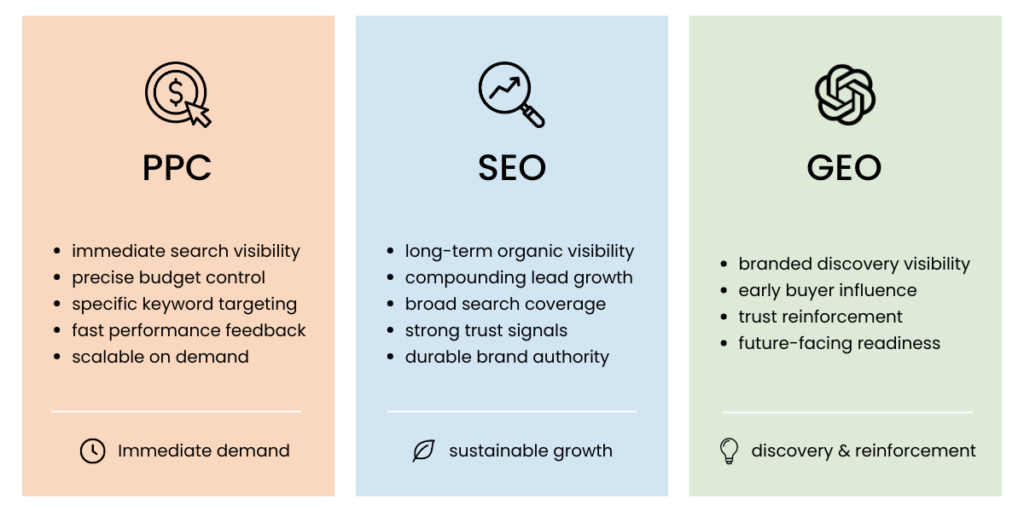
Do SEO, PPC, and AI Compete With Each Other?
In some cases these channels can appear to compete in the same digital real estate. A single search might show a paid ad, an organic listing, and an AI-generated answer all at once. So which one does the user click on?
The reality is that this isn’t actually a problem. It’s a reflection of how people consume information today. Some users trust ads when they’re ready to act. Others scroll past ads and look for organic results they can explore. An emerging demographic never clicks on anything at all and relies on the AI summary to shape their decision. Each behavior is valid, and each channel serves a different type of user at a different stage of intent, depending on the query.
What matters most is consistency. When your brand appears in multiple plots of a search, it reinforces credibility rather than creating unnecessary competition. Seeing the same business mentioned in an ad, an organic result, and an AI response builds familiarity and confidence. Even if only one of those placements earns the click, the others still play a role in influencing the decision. Instead of competing against each other, PPC, SEO, and GEO often work together to strengthen the likelihood of conversion.
How to Choose Between PPC, SEO, and GEO
Here’s a simple “choose your own adventure” style decision tree:
Choose PPC First If You Need Leads Right Now
- You need leads now, not tomorrow
- You’re launching something new: service, offer, or location
- You can afford the cost of paid clicks and track conversions
Choose SEO First If You Want Long-Term Success
- You want growth that compounds over time
- Your customer researches and compares before calling you
- You serve multiple towns and don’t want to pay for every ad click
Choose GEO First If You Want to Get Ahead of the Curve
- Your audience is already using AI tools to research options
- You want your brand showing up in answers, not just links
- You’re comfortable investing early in emerging channels
- You want to reinforce trust across multiple discovery points
Choose a Blended Strategy for Speed and Stability
If you want to truly dominate in search, you’ll want to blend PPC, SEO, and GEO together to appear in as many results as possible.
To get the most value from each channel and match how people search at different stages, use:
- PPC for bottom-of-funnel searches like “appointment near me” or “emergency plumber,” where speed and intent matter most.
- SEO for research-driven searches like “cost of a new roof” or “what’s the difference between a plumber and a handyman?”, where people are comparing options and building confidence.
- GEO for exploratory questions and recommendations such as “who should I hire for roof repair?” or “what’s the best way to fix a leaking pipe?”, where AI tools shape early opinions before a click ever happens.
4 Common Search Mistakes CT Businesses Should Avoid
1. Treating PPC, SEO, and AI as Separate Silos
These channels influence the same buying journey. When they aren’t aligned, messaging breaks down and opportunities are missed. PPC, SEO, and GEO all impact the buyer’s journey in search.
2. Expecting Instant Results From Every Channel
PPC, SEO, and GEO all move at different speeds. Expecting them to perform the same way leads to poor decisions and early abandonment of strategies that need time.
3. Ignoring Branded Search Demand
If people are searching for your business name and you’re not controlling that experience through organic listings and paid coverage, you’re leaving trust and conversions on the table.
4. Treating SEO Like a One-Time Project
SEO is not a one-time fix. The competition is always updating their websites, and search engines are always updating their results. Your website needs maintenance, too.
5. Sending Paid Traffic to Weak Landing Pages
If your paid ads are good but your landing pages are slow, vague, confusing, or being used for other marketing objectives, you’re throwing your money away.
6. Skipping Conversion Tracking
If you can’t attribute your spend and to real results, such as calls, form fills, and booked appointments, then you’re essentially flying blind.
7. Chasing Keywords Instead of Intent
Ranking for high-volume terms doesn’t matter if they don’t match what your customers are actually trying to do. Focus on searches that signal real intent, not just traffic.
8. Forgetting Connecticut Is Town-by-Town
Search behavior and competition can change fast from one town to the next. Stamford isn’t Ridgefield. Norwalk isn’t New Haven.
How Aspire Digital Solutions Helps CT Brands Win With SEO, PPC, and AI Search
At Aspire Digital Solutions, we don’t start with packages. We start with outcomes. Our job is to help Connecticut businesses choose and execute the search strategy that will actually drive leads, growth, and measurable results.
Based in Ridgefield, CT, we work closely with local brands to understand what success looks like for their business before recommending SEO, PPC, GEO, or a combination of all three. In most cases, we begin with a few foundational questions:
- How quickly do you need to see results?
- What is a qualified lead worth to your business, and how often do those leads convert?
- What does competition and search demand look like in your specific Connecticut market?
Those answers guide everything that follows. From there, we build a strategy that aligns with your goals, your timeline, and your market, then focus on execution, testing, and refinement to ensure the strategy performs. The result is a clear path forward, backed by data, not assumptions.
Ready to Decide Between SEO, PPC, or GEO for Your Business?
If you’re still on the fence about which strategy to pursue, or if you’re considering combining them, especially in this new world of AI-powered search results, we can help you figure it out in no time.
Contact us today, and we’ll review what you’re working with, what your goals are, what your market is in Connecticut, and what will really work for you. Then, we’ll recommend a strategy that works for you, without guessing.
If you’re ready for a straightforward conversation about search marketing, give us a call at (203) 208-3165 or email hello@aspiredigitalsolutions.com.



0 Comments