










Ranking in Google search results and getting branded mentions in AI tools like ChatGPT can be a difficult, time-consuming process. Even if you create a piece of content that is the most helpful, robust, and comprehensive resource available on the internet for a specific keyword, you still might not be able to rank. While there are over 200 factors that contribute to organic Google search rankings, one of the most overlooked is topic clusters and topical authority.
Search engines and AI systems do not evaluate the power of a page in isolation. They are also evaluating the domain, as a whole. If your website has only one article about the topic you want to rank for, then it is very difficult to convince search tools that you are the trusted expert on the subject matter.
Search platforms like Google and ChatGPT need to understand that you understand the subject broadly, not just narrowly. AI tools like ChatGPT operate similarly. They look for patterns of credibility and consistency before surfacing or citing a brand.
Great content matters, but great content in isolation is rarely enough. Depth, structure, and demonstrated expertise across an entire topic area are often what separate page-one rankings and AI visibility from pages that never gain traction.
What Are Topic Clusters in SEO?
A topic cluster is a way of organizing your website content so that everything on a given subject is connected and works together.
It starts with one pillar page — a broad, comprehensive page on a core topic. From there, you create supporting pages that each dive deeper into a specific angle of that topic. All of these pages link to each other intentionally, which helps search engines understand how your content relates and which page is most authoritative.
Here’s what that might look like if you want your site to be an authority on Content Creation:
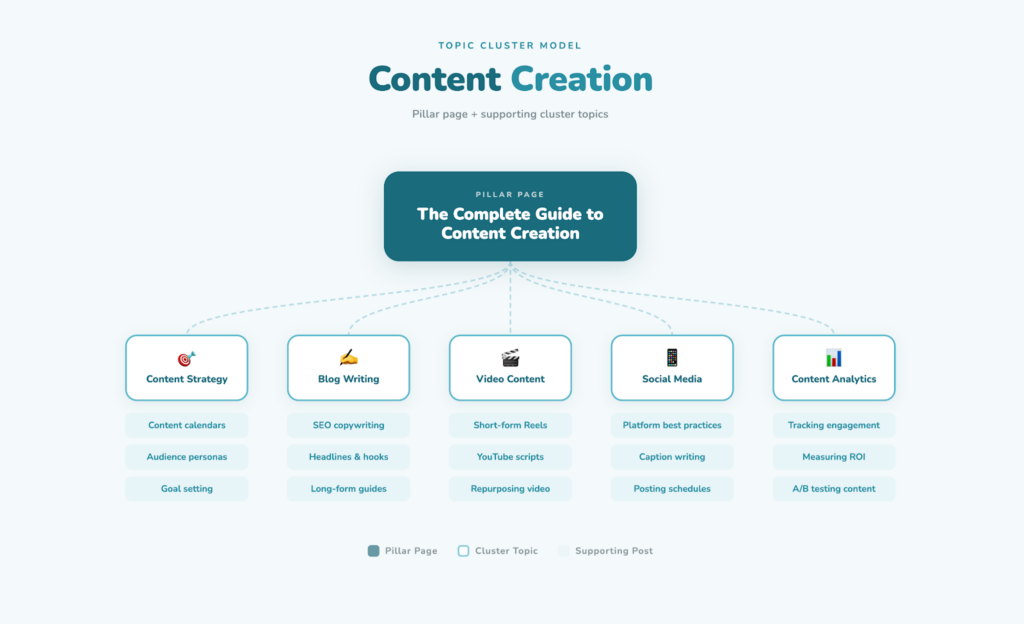
The more specific a sub-topic is, the less competition you’ll run into, making it easier to rank. And as you rank for those smaller, more specific terms, you build trust to be considered for the bigger topic at the top.
Think of it like building a house or a pyramid. You have to lay a reliable, trustworthy foundation before you can expect to build the rest of the structure.
Over time, this tells search engines three things:
- What topics and themes define your site entity
- Where your industry expertise actually lives
- Which page is the authoritative source on each topic
How Topic Clusters Help You Outrank Search Competitors
Google’s mission is to surface the most helpful answer possible. That’s what has kept us coming back to their platform year after year. “Googling” didn’t earn its place as a verb in our modern vocabulary by accident. And because Google holds its results to such a high standard, it takes real, consistent effort for a URL to earn that top spot. Here’s the thing though: Google doesn’t just analyze an individual page. It has to trust a whole site.
When you publish one article about a topic, you’re making a claim. When you publish ten interconnected articles about that topic from every angle, you’re communicating expertise. Topic clusters turn your website into a trusted resource rather than a collection of random pages, and Google rewards that depth with higher rankings.
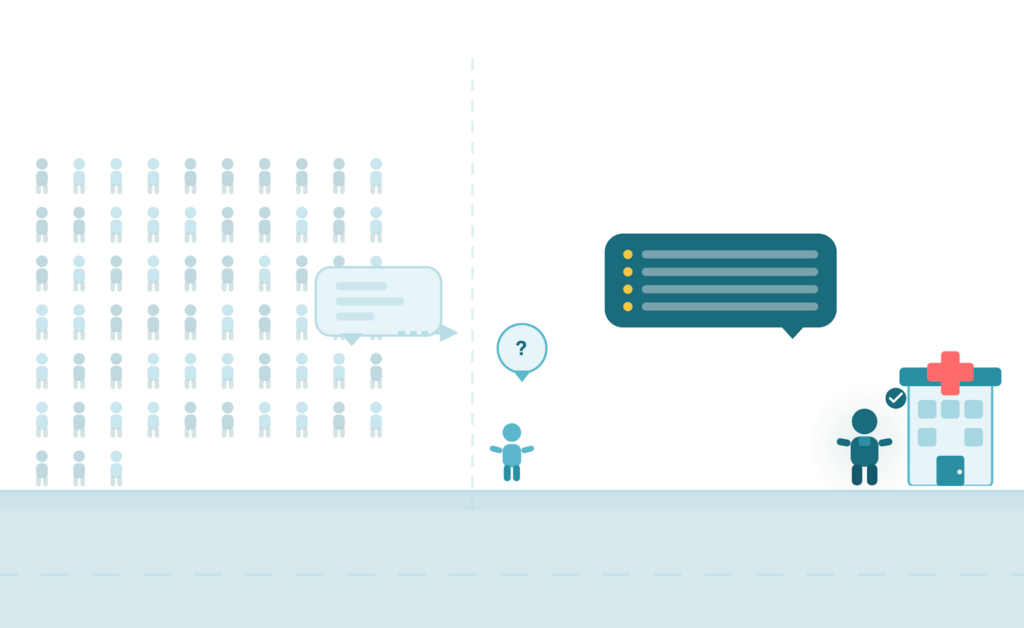
Think about it from a different angle. If you asked 100 people on the street for directions to the nearest hospital, you’d probably trust the one who knew the cross streets, the fastest route, the parking situation, and the best entrance to use over the one who just said “It’s that way.”
Knowledge depth signals credibility in real life. The same goes for search and SEO.
Before you build a cluster, it’s worth understanding the competitive landscape you’re stepping into. Your competitors likely have a page or two on the same subjects you’re targeting. But if your site has an entire ecosystem of content built around that subject, with a strong pillar page backed by more supporting posts than your competitors, you become much harder to outrank. You’re not just showing up. You are the authority.
The sites that dominate search results typically aren’t winning on one great resource. They’re winning because Google trusts them as the expert. Topic clusters are how you build that trust, systematically and over time.
Pillar Pages vs. Cluster Pages: What’s the Difference?
A pillar page is your broadest, most comprehensive piece of content on a given topic, typically over 2,000 words at minimum. It’s not trying to go deep on any one thing. It’s meant to cover a sampling of the full landscape, give readers a strong foundation, and act as the authoritative hub that everything else connects back to. Think of it as the front door to your expertise on a subject or a long-form table of contents.
Cluster pages are where you go deep. Each one takes a specific subtopic from the pillar and explores it thoroughly as a blog article, answering the detailed questions that your audience is actually searching for. They exist to support the pillar, and in return, the pillar lends them authority by linking to them.
The relationship between the two is what makes the strategy work. The pillar page is designed to earn broad trust on a subject. The cluster pages earn trust on the specific components of the subject.
Most importantly, these two page types have to be talking to each other. Your pillar page should link out to each of its supporting cluster pages, and those cluster pages should link back to the pillar. That internal linking structure is what ties the whole ecosystem together and tells Google exactly how your content is organized, what each page is about, and where the authority lives.
How to Build a Topic Cluster Strategy: 4 Steps
- Pick a topic that is directly related to something you’re trying to sell or be known for. If it’s not something you actually sell or support, it won’t be worth the effort and you might confuse Google down the road when you do what to rank for a conversion-oriented topic. Use keyword research tools like Ahrefs, SEMrush, or even Google Ads’ Keyword planner to ensure you’re targeting the highest volume keyword variant possible.
- Identify the subtopics that your customers naturally ask about. Use Google’s “People also ask” section to get some initial ideas here. Or type your keyword into those keyword research tools, and scroll down to view different ways that people search for them. Chances are, you’ll probably already have a good idea of questions your customers have simply by being in your industry. Leverage that experience from sales calls, intake forms, emails, and reviews, and test your assumptions.
- Ensure that each page targets a completely dedicated and unique keyword silo. One might be a page about costs. Another might compare your pillar topic to another topic. One might talk about challenges of your pillar topic. If you feel like any of the pages you’re creating are too similar, then don’t move forward with them. You don’t want your pages competing against each other in search.
- Connect everything using internal links. The pillar page should link out to each of the supporting pages, and each of the supporting pages should link back to the pillar page. If two of the supporting pages are naturally related to each other, those should also be linked together.
Topic Cluster Mistakes That Hurt SEO Rankings
Even with the right strategy in place, there are a few common mistakes that can quietly undermine your results.
Skipping the internal links. A topic cluster without intentional internal linking is just a collection of pages. The links are what create the structure, pass authority between pages, and signal to Google how everything connects. If your pillar and cluster pages aren’t linking to each other, you’re leaving most of the value on the table.
Building clusters around topics you can’t actually own. If you’re a small or newer site, going head to head with established domains on highly competitive topics is a tough road. The smarter move is to start with topics where you have a realistic shot at ranking, build trust in that space, and grow from there.
Targeting the same keyword on multiple pages. This one chips away at your own rankings without you even realizing it. Every page in your cluster needs a clear, distinct search intent. If two pages are competing for the same term, neither one is going to perform the way it should.
Publishing thin cluster pages. Cluster pages need to actually answer the question they’re targeting. A short, surface-level post doesn’t build trust with Google or with your readers. Depth and usefulness are what earn rankings.
Treating the pillar page as a one-time project. Your pillar page should grow as your cluster grows. As you publish new supporting content, update the pillar to reflect it. A pillar page that never gets touched starts to feel stale. Especially since we’re seeing that AI search tools like ChatGPT, Perplexity, and Gemini have a strong recency bias and prefer to feature new, fresh pages in their results. If you’re thinking about Generative Engine Optimization (GEO) at all, keeping your pillar page current should be a big part of the strategy.
How to Measure Topic Cluster SEO Performance
Building a topic cluster takes time. The key is knowing what to watch so you can tell whether it’s gaining momentum or just creating more content without impact.
Here’s what actually matters:
Organic traffic to the pillar page
This is your main indicator. As you publish supporting articles and strengthen internal links, traffic to the pillar page should gradually increase. If it’s flat, the cluster hasn’t fully taken hold yet.
Impressions and search visibility
Traffic usually follows visibility. In Google Search Console, look at impressions for both the pillar and cluster pages. If impressions are rising, Google is starting to show your content more often. That’s often the first sign things are working.
Keyword rankings for cluster pages
Track how each supporting article ranks for its main keyword. As those pages move up, it signals growing authority around the broader topic. When cluster pages strengthen, the pillar benefits too. They support each other.
Internal traffic between pages
Are readers clicking from the pillar to related articles and back again? Healthy movement between pages means your structure makes sense and your content is genuinely helpful.
Indexing and crawl status
If a page isn’t indexed, it can’t contribute to your authority. Make sure Google is finding and indexing every cluster page.
Backlinks to the pillar page
Over time, strong pillar content should attract links naturally. Backlinks to the pillar are one of the clearest signs your topic cluster is building authority.
Engagement metrics
Time on page and bounce rate matter. If people leave quickly, the content may not be matching intent. Strong clusters keep readers engaged and exploring more.
The most important thing to remember is that topic clusters are a long term strategy. Results rarely show up in a few weeks. Give it time, continue building out the cluster, and let authority compound.
Get a Topic Cluster Plan Created for Your Website!
If you want your website to be the clear, trusted resource in your space, it takes more than publishing random blog posts. It requires structure, strategy, and intentional depth.
A well built topic cluster does more than increase traffic. It positions your brand as the authority that search engines, AI tools, and users trust the most.
If you’re still wrapping your head around topic clusters and how to get started, we can help map it out for you. The SEO team at Aspire Digital Solutions will identify the highest value pillar topic based on your core services, outline the supporting pages that strengthen it, and create a practical internal linking plan you can actually execute.
Instead of guessing what to publish next, you will have a clear roadmap designed to build long term visibility and measurable growth.
Let’s build it the right way. Reach out today to start developing a topic cluster strategy tailored to your business.



0 Comments