











A fully optimized Google Business Profile is one of the highest-leverage moves a local business can make.
When someone searches “commercial cleaner near me” or “best dentist in [city],” Google often serves up a map pack before a single organic result. The businesses that show up there are not just the closest ones. They are the ones with the most optimized profiles.
This guide breaks down exactly how to optimize your Google Business Profile from top to bottom, including a 34-point checklist you can work through today.
Why Your Google Business Profile Matters for Local SEO
Depending on the industry you’re in, your Google Business Profile (or “GBP”) can get more visibility than your actual website.
When someone searches for a local service, Google frequently shows the map pack above all organic results. That means your GBP listing is sometimes the first thing a potential customer sees, before they ever land on your site.
A well-optimized profile can:
- Push your business into the map pack for high-intent local searches
- Drive more calls, direction requests, and website clicks
- Build credibility through reviews, photos, and consistent activity
- Signal to Google exactly what your business does and where you do it
For local businesses, GBP optimization is not a “nice-to-have.” It is one of the most impactful tactics available to improve organic search visibility.
Understanding How Google Ranks Businesses in Map Listings
Before diving into the checklist, it helps to understand how Google actually ranks businesses in local search. Google uses three core factors.
Relevance
Relevance refers to the relationship between your business and the search term used. For instance, when someone looks up “emergency plumber near me” on Google, Google expects to find businesses whose main focus is emergency plumbing services.
The GBP’s primary business category, secondary category, service offering, business description, website content, and customer reviews all play a critical role in helping Google establish the relevance of your business.
Trust
Trusted businesses are more likely to be featured in both traditional search results and map listings. But how does Google evaluate trust? Some of the factors that Google considers when evaluating how trustworthy a business is include the quality of its reviews, external citations, backlinks, branded mentions, and website performance in traditional search results.
A business with 150 detailed reviews, consistent citations across the web, and a reputable website that ranks for industry-relevant keywords will outrank a competitor with a half-finished profile and 12 reviews from three years ago.
Trust is not built overnight, and every action taken to improve it compounds over time. A consistent, ongoing effort to build trust signals is essential for businesses that want to compete in map results.
Proximity
Proximity is how close your business is to the person searching, or to the location they specify in their query. Someone searching from downtown Stamford will see different results than someone searching from a town 20 miles away, even if they use the exact same search terms.
Proximity cannot be directly manipulated. What can be controlled is making sure your address, service areas, location pages, and citations are all accurate and consistent everywhere your business appears online.
How to Claim or Create a Google Business Profile
If you haven’t set up your profile yet, start here:
- Go to Google Business Profile
- Search for your business name
- Claim the existing listing, request access, or create a new one
- Complete the verification process (if needed)
Once verified, you can begin optimizing your profile.
The Google Business Profile Optimization Checklist: 36 Points to Improve Visibility
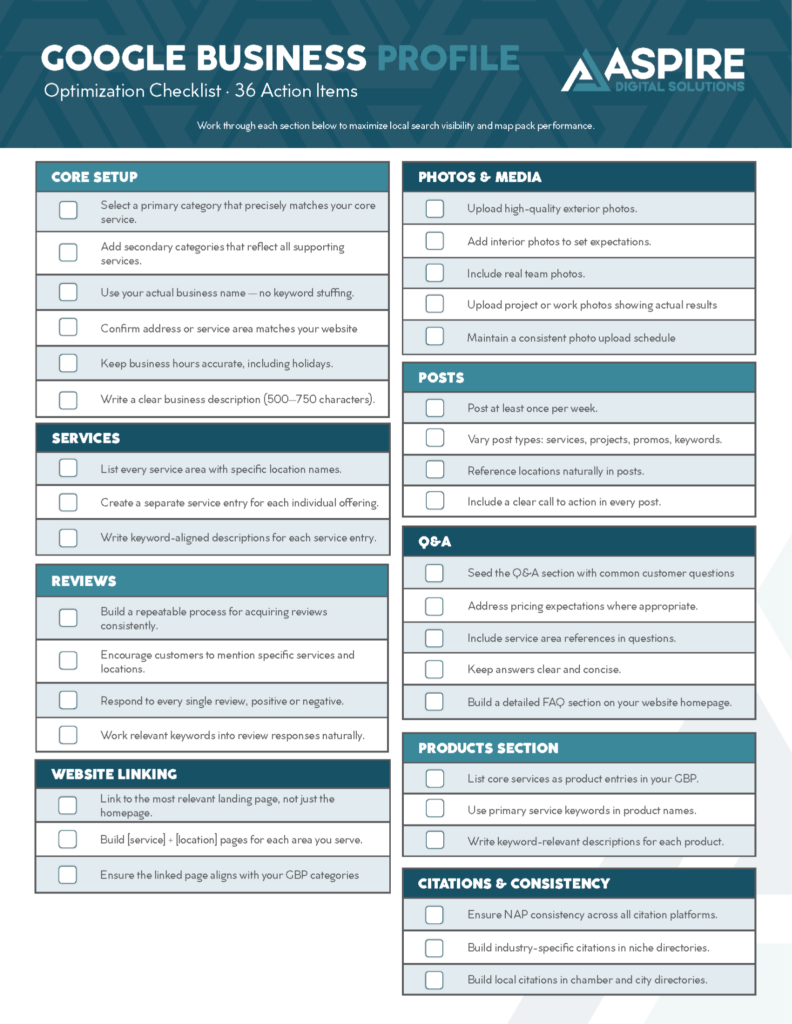
Download the full checklist here.
Core Setup
- Select a primary category that precisely matches your core service. This is the single most important category decision you will make.
- Add secondary categories that reflect all supporting services your business offers.
- Use your actual business name. Do not stuff keywords into it. Google treats this as a spam signal and it can get your listing penalized or suspended.
- Confirm that your address or service area is accurate and matches what is listed on your website.
- Keep business hours accurate at all times, including holidays and special hours. Outdated hours erode trust fast.
- Write a business description that summarizes your services and locations clearly. Aim for 500 to 750 characters and lead with your most important keyword-aligned services early in the copy.
Services
- List every service area your business covers if you operate as a service-area business, with specific location names where possible.
- Create a separate service entry for each individual offering rather than grouping everything into one.
- Write keyword-aligned descriptions for each service entry. These descriptions contribute to relevance signals.
Reviews
- Build a repeatable process for acquiring reviews consistently. A sudden spike followed by silence looks unnatural. Steady, ongoing reviews look legitimate.
- Encourage customers to mention specific services and locations in their reviews. A review that says “best carpet cleaning in White Plains” carries more weight than a generic five-star rating.
- Respond to every single review, positive or negative. Response rate signals engagement to Google and builds trust with potential customers reading the reviews.
- Work relevant keywords into review responses naturally where it makes sense. Do not force it.
Photos and Media
- Upload high-quality exterior photos so Google and customers can visually confirm your location.
- Add interior photos that give people a sense of what to expect.
- Include real photos of your team. Faces build trust in a way that stock images never will.
- Upload project or work photos that show actual results. Before and after photos work particularly well for service businesses.
- Maintain a consistent photo upload schedule, whether weekly or monthly. Profiles that go months without new photos signal inactivity.
Posts
- Post at least once per week. Treat GBP posts like a social media feed that directly feeds local SEO signals.
- Vary post types: service-focused posts, recent project highlights, seasonal promotions, and keyword-targeted content all serve different purposes.
- Reference locations naturally in posts where relevant. “Now serving Danbury, CT” works better than just “now serving new areas.”
- Include a clear call to action in every post. Tell people exactly what to do next.
Q&A Section
- Seed your own Q&A section with common customer questions. You can do this anonymously. Do not leave this section empty and uncontrolled.
- Address pricing expectations where appropriate. Many searchers want a ballpark before they ever call.
- Include service area references in questions to reinforce local relevance signals.
- Keep answers clear and concise. This is not the place for lengthy sales copy.
- Build out a detailed FAQ section on your website homepage. Google now pulls information from connected domains when evaluating GBP relevance, and is shifting to feature on-page FAQs in GBP snippets.
Products Section
- List your core services as product entries within the GBP. Many businesses skip this entirely, which is a missed opportunity.
- Use primary service keywords in product names.
- Write brief, keyword-relevant descriptions for each product entry.
Website Linking
- Link to your most relevant landing page based on what your profile is optimized for, not just the homepage.
- Build out [service] + [location] pages on your website if you serve multiple areas. These pages reinforce local relevance for your GBP and support organic rankings simultaneously.
- Make sure the linked page content aligns with the categories and services listed in your GBP. Misalignment here confuses Google.
Citations and Consistency
- Ensure NAP consistency across all existing citation platforms like Yelp, Yellow Pages, Bing Places, etc. NAP stands for “name, address, and phone number”, but it has evolved to mean more than those 3 basic items. Your business description, hours, website url, and socials should all be duplicated identically across all directory submissions and citation sources. Tools like BrightLocal’s citation builder are a great place to start here to ensure consistency.
- Build industry-specific citations on directories that specifically represent what you do.
- Build local citations in relevant directories such as chamber of commerce listings or city/county-specific business directories.
Common Google Business Profile Mistakes to Avoid
Even businesses that put effort into their GBP often make a handful of mistakes that quietly hold them back. Here are the most common ones:
- Keyword stuffing the business name. This violates Google’s guidelines and can lead to suspension.
- Choosing the wrong primary category. If the primary category does not match the core service, relevance signals are weakened from the start.
- Inconsistent NAP information across directories. Conflicting information confuses Google and undermines local authority.
- Ignoring reviews or responding too slowly. Both signal a disengaged business owner.
- Uploading photos in batches and then going dark. Sporadic activity looks worse than no activity at all to Google’s freshness signals.
- Linking to the homepage by default. While not always a mistake, if someone clicks through from a GBP for a specific service, they should land on a page for that service, not a generic homepage.
Maximize Local Search Visibility with Google Business Profile Optimizations
The businesses that dominate local map pack results are not necessarily the biggest or the oldest. They are the ones that treat their GBP as an active, ongoing asset rather than a one-time setup task.
Work through the checklist above, prioritize the core setup and review sections first, and build from there. Consistency over time is what separates businesses that show up everywhere locally from those that barely show up at all.If you’re interested in improving your local visibility and generating more leads, then this guide provides a solid basis to get started. Concentrate on optimizing the basics first, and keep updating your profile as your company evolves. Contact us today to start improving your local visibility.




0 Comments